In the vast ecosystem of industrial motion control, the stepper system represents one of the most widely deployed and fundamentally important technologies. At its core, a stepper system is an open or closed-loop motion control solution that converts digital pulse commands into precise incremental shaft rotation. It is composed of three primary components: a controller (often a PLC or motion card), a stepper drive (also called a driver or amplifier), and a stepper motor. This trio works in concert to achieve controlled movement without the need for a traditional feedback sensor, although modern versions often include encoders for verification. The essence of stepper motion control lies in its simplicity, reliability, and excellent holding torque at standstill, making it the go-to choice for a multitude of point-to-point positioning applications. As a world-leading designer and manufacturer, Leadshine provides a complete ecosystem for stepper motion control, from advanced drives like the EM3E Series to high-performance CM Series motors, enabling engineers to implement robust and cost-effective automation across diverse industries.
Core Components and Their Functional Synergy
A complete stepper system operates through the precise interaction of its key elements. The process begins with the controller, which generates a stream of digital pulse and direction signals. Each pulse corresponds to a single, discrete step of the motor shaft. The frequency of these pulses determines the motor’s speed, while the number of pulses dictates the distance traveled. These low-voltage command signals are sent to the stepper drive. This critical component acts as the system’s power brain. The stepper drive receives the logic-level pulses and amplifies them into high-power current pulses that are delivered to the phases of the stepper motor. The motor’s internal design, featuring a toothed rotor and multiple electromagnetic stator phases, causes the rotor to align with the energized magnetic field. By sequentially energizing the phases in a precise pattern determined by the drive’s control logic, the rotor advances in small, discrete angular increments, or “steps.” This direct digital-to-mechanical conversion is what defines the foundational principle of a stepper system.
Key Operating Modes: Open-Loop and Closed-Loop Control
Traditional stepper motion control operates in an open-loop configuration. In this mode, the controller sends a predetermined number of pulses with the assumption that the motor will perfectly execute each step. This mode is valued for its simplicity and low cost. However, it carries the inherent risk of “step loss” if the motor encounters an unexpected load, inertia, or resonance that it cannot overcome, leading to an uncaught positional error. To address this, modern stepper system technology has evolved to incorporate closed-loop control. In a closed-loop stepper system, an encoder is attached to the motor shaft, providing real-time feedback on the rotor’s actual position to the drive. Drives like Leadshine’s CS Series (e.g., CS2RS, CS3E) utilize this feedback to monitor for following errors. If a discrepancy between commanded and actual position is detected, the drive can instantly increase current to correct the error, guaranteeing “no loss of step.” This hybrid approach merges the cost-effectiveness of a stepper with the reliability of servo-like verification, significantly expanding the application range of stepper motion control.
Technical Advantages and Performance Characteristics
The widespread adoption of stepper systems is driven by a set of distinct advantages. First is excellent low-speed torque and holding capability. A stepper motor can provide full rated torque at zero speed, making it ideal for applications that require a strong holding force or must start under load. Leadshine’s CM Series motors are engineered for “high torque in all speed ranges.” Second is simplicity and ease of control. The digital pulse interface is straightforward to implement with any standard PLC or microcontroller, avoiding the complex tuning associated with servo loops. Third is high reliability and durability. With no brushes to wear out and a robust mechanical construction, stepper motors offer long service life. Fourth is precision. The movement is defined in fixed, repeatable step angles (e.g., 1.8° per full step, which can be divided into microsteps for smoother motion). Modern drives from Leadshine achieve “low noise and vibration, smooth motion” through advanced microstepping and current control algorithms, enhancing precision and finish quality.
Common Applications and Industry Implementation
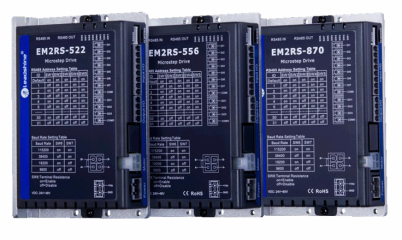
The practical utility of a stepper system is demonstrated by its prevalence across countless automation sectors. Its strengths shine in applications requiring precise indexing, positioning, and speed control without extreme dynamic demands. In packaging machinery, stepper systems control the intermittent motion for filling, capping, and labeling stations. In digital printing and scanning, they provide the precise linear positioning for print heads or imaging sensors. CNC machinery utilizes them for controlling auxiliary axes like tool changers, coolant nozzles, or for the main axes in smaller routers and engravers. Medical and laboratory automation employs them in fluid handling pumps, syringe drives, and microscope stage controllers due to their precise volumetric control. Leadshine frequently cites applications in textile, solar equipment, 3C electronics, and general automation for its products, underscoring the versatility of a well-designed stepper motion control solution. The company’s EM2RS Series, with its built-in multi-segment position table (PR mode), is a perfect example of a stepper system component that simplifies machine design by allowing standalone, complex sequential motion without a sophisticated central controller.
Evolution and Integration with Modern Networks
The contemporary stepper system is far more advanced than its predecessor. Integration with industrial networks is a key development. Modern stepper drives from suppliers like Leadshine now feature fieldbus connectivity, such as EtherCAT (EM3E/CS3E Series) or EtherNet/IP (2EM3EIP Series). This transforms the stepper system from a simple pulse-follower into an intelligent, networked node. Over EtherCAT, for instance, a drive can receive high-level motion commands (profile position, velocity) from a central PLC, report detailed diagnostics, and synchronize perfectly with other axes on the network. This enables sophisticated multi-axis coordination and seamless integration into Industry 4.0 architectures. Furthermore, features like dual-axis control—where a single drive like the 2EM3E controls two motors—exemplify how modern stepper motion control is evolving towards higher density and efficiency, saving significant space, cost, and network complexity.
In conclusion, a stepper system is a fundamental, versatile, and highly effective motion control solution built on the principle of digital pulse-to-step conversion. Its composition of controller, drive, and motor provides a balance of precision, torque, and cost that is unmatched for a vast array of applications. The technology has matured from simple open-loop operation to include intelligent closed-loop verification and seamless industrial network integration. Through its comprehensive portfolio of drives, motors, and control solutions, Leadshine empowers engineers to leverage the full potential of stepper motion control. By understanding the principles, components, and evolving capabilities of the stepper system, designers can make informed choices to implement reliable, accurate, and economical automation across the manufacturing landscape.
