Choosing commercial garment-printing equipment requires more than comparing purchase prices or advertised print speeds. Apparel manufacturers, custom T-shirt businesses, and print-on-demand providers need reliable output, consistent image quality, manageable maintenance, and efficient production workflows. Evaluating the right performance metrics helps buyers determine whether a direct-to-garment system can meet current order requirements while supporting future business growth.
Production Speed and Practical Output
Production speed is one of the first metrics buyers should examine. However, advertised printing speed does not necessarily represent the number of finished garments a business can deliver per hour. Loading, garment preparation, unloading, curing, and quality inspection all affect actual throughput.
Buyers comparing a direct to garment printer for sale should request production data under clearly defined print settings. They should also test representative designs, including detailed graphics and white-ink prints on dark garments, to understand how different jobs affect output.
A useful benchmark is the number of acceptable finished garments produced per hour. Tracking this figure over several shifts provides a more realistic basis for estimating capacity, labor requirements, and delivery schedules.
Print Quality and Color Consistency
Commercial customers expect logos, illustrations, photographs, and fine text to look consistent across repeat orders. Print quality should therefore be evaluated through detail reproduction, color accuracy, white-ink coverage, and consistency between garments.
Printhead configuration influences ink placement and image reproduction, but results also depend on ink compatibility, artwork preparation, RIP settings, fabric characteristics, and maintenance. Buyers should request sample prints featuring different colors, fine lines, gradients, and small text.
Fabric selection matters as well. Cotton and cotton-rich garments are common DTG applications, while other textiles may require additional testing. A production trial helps determine whether the equipment can meet customer expectations without excessive reprints.
Integrated Pre-Treatment and Workflow Efficiency
Pre-treatment is an important part of DTG production, particularly when printing white ink or vibrant colors on dark garments. In a conventional workflow, this step may require separate equipment and additional handling.
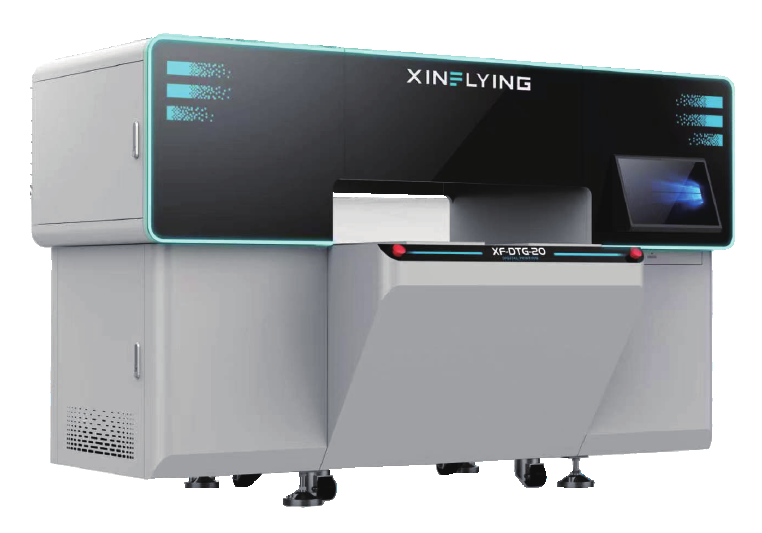
An integrated system can simplify production by bringing garment preparation and printing together. The XF-DTG-20-2I16A1+4I32A1 from Xinflying is designed as a pre-treatment and printing all-in-one solution. Its double-suction configuration is intended to improve efficiency, while the integrated workflow reduces the need to coordinate separate processing stages.
For businesses comparing a direct to garment printer for sale, the key question is whether this arrangement reduces total processing time while maintaining consistent pretreatment and print quality. Sample testing and workflow observation can help verify its practical value.
Ink Management and Maintenance
White ink requires particular attention because pigment settling can affect ink delivery and printing reliability. Buyers should examine whether the printer provides circulation, stirring, cleaning functions, and clear maintenance procedures.
The XF-DTG-20-2I16A1+4I32A1 includes a white-ink circulation and stirring system designed to help prevent sedimentation. Its one-click ink priming and cleaning functions simplify routine maintenance, helping operators manage essential tasks more conveniently.
These features do not eliminate maintenance requirements. Businesses should still evaluate nozzle checks, cleaning frequency, ink consumption, and downtime. A dependable Xinflying DTG printer manufacturer should provide practical guidance on equipment care, troubleshooting, and consumable compatibility.
Garment Compatibility and Printhead Clearance
Production flexibility matters for businesses handling different garment styles, thicknesses, and customer specifications. Buyers should check the maximum supported material thickness, platen dimensions, and adjustment mechanism before selecting a machine.
The XF-DTG-20-2I16A1+4I32A1 features a motorized lift print carriage that accommodates materials of various thicknesses. This adjustment capability can help operators manage different garment requirements more conveniently.
Nevertheless, compatibility should be verified through testing. Seams, pockets, uneven surfaces, and garment construction may affect positioning and printhead clearance. Establishing approved garment settings helps reduce collision risks and maintain repeatable production quality.
Calculate Output Costs and Equipment Reliability
A printer’s commercial value depends on more than its initial price. Buyers should estimate ink consumption, pretreatment supplies, labor, electricity, routine maintenance, replacement components, and rejected garments.
Equipment reliability also influences profitability. Record downtime, maintenance hours, and the number of failed prints to understand how much production capacity is actually available. These measurements help businesses compare different machines using cost per acceptable garment rather than purchase price alone.
When evaluating a direct to garment printer for sale, buyers should request warranty details, technical support arrangements, training information, and spare-parts availability. A supplier’s ability to assist with installation and troubleshooting can be important when production deadlines are tight.
Verify Specifications Before Purchasing
A practical equipment assessment should include a demonstration using representative artwork and garments. Buyers should confirm print quality, usable output, pretreatment consistency, supported garment thickness, and maintenance requirements.
Xinflying offers the XF-DTG-20-2I16A1+4I32A1 for businesses seeking integrated garment preparation and printing. Its white-ink circulation and stirring system, one-click ink priming and cleaning, and motorized lift print carriage address several operational considerations relevant to commercial production.
Businesses should confirm the current machine configuration, technical specifications, included accessories, and service terms directly with the supplier before placing an order.
Choose Performance That Supports Business Growth
Selecting the right DTG printer requires a balanced assessment of speed, print quality, workflow efficiency, maintenance, garment compatibility, and operating costs. No single metric can determine whether a machine will perform well in every production environment.
For apparel businesses considering a direct to garment printer for sale, testing real jobs and calculating finished-garment output provide a stronger purchasing foundation than relying on advertised claims alone. By comparing measurable performance indicators and support arrangements, buyers can identify equipment that fits their production requirements and supports sustainable business growth.
