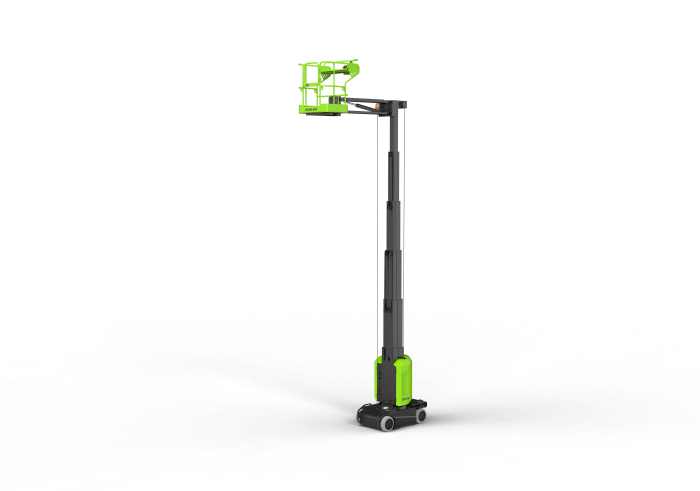
Facility maintenance often involves work above normal reach but inside spaces where construction-sized equipment is impractical. A vertical mast lift can provide elevated access for lighting, ceiling services, signage, HVAC components, inspection points, and other routine tasks. For hotels, hospitals, and offices, the machine must do more than reach height: it must fit the building, move with control, and support planned maintenance without creating unnecessary disruption.
Why Indoor Facilities Need Compact Access Equipment
Hotels, hospitals, and offices have a different operating environment from open construction sites. Corridors may be narrow, entrances may be busy, and floor finishes or occupied areas may limit how equipment can be positioned. A suitable access machine should therefore combine sufficient elevation with manageable dimensions and controlled movement.
Facility teams should also consider how often equipment is relocated during a work order. A lift that can travel between task areas efficiently can reduce setup time, while a compact turning path can make repositioning easier around furniture, partitions, service areas, and pedestrian routes. Planning should always account for the building layout and local site controls.
Hotel Maintenance Applications
Hotels frequently need access equipment for lighting replacement, decorative feature maintenance, ceiling-mounted equipment, signage, and inspection work in guest rooms, corridors, lobbies, restaurants, and back-of-house areas. These tasks can be difficult when fixed access systems cannot reach the work point or when portable ladders do not provide the desired working position.
A mobile platform can also support scheduled maintenance in areas that need to remain operational. Teams can plan work during quieter periods, move between locations as tasks are completed, and keep equipment aligned with the work area. In guest-facing environments, low-noise electric operation and careful travel control can also be practical considerations, subject to the specific machine and site conditions.
Hospital Maintenance Applications
Hospitals create additional access challenges because corridors, treatment areas, service rooms, and circulation routes can remain active throughout the day. Maintenance planners may need to reach lights, ceiling services, signs, ventilation components, and building infrastructure while protecting pedestrian movement and sensitive areas.
The correct equipment should be selected by considering floor conditions, doorway and route dimensions, ceiling height, load requirements, and the location of overhead hazards. OSHA emphasizes pre-start inspections, work-area inspections, operator training, and following the manufacturer’s requirements for aerial lifts. These controls remain important even when a machine is used for routine indoor maintenance.
Office Facility Applications
Office buildings often require recurring work above suspended ceilings, around lighting systems, signage, air-conditioning components, and other building services. The challenge is frequently not extreme height but reaching the correct point without moving bulky equipment through occupied workspaces.
A compact access platform can be useful where maintenance teams must move between offices, meeting spaces, corridors, or shared facilities. However, equipment selection should consider floor loading, access routes, elevator restrictions, working height, platform capacity, and traffic management. HSE guidance also highlights the importance of choosing the appropriate MEWP, planning its use, providing training, and maintaining inspection and servicing programs.
Selecting the Right Vertical Mast Lift Platforms
When comparing vertical mast lift platforms, buyers should start with actual maintenance tasks rather than choosing solely by maximum height. The required platform height, rated capacity, number of occupants, working slope, turning radius, and stowed dimensions should all match the facility.
Battery configuration and drive characteristics also matter for recurring indoor work. Travel speed, raised driving speed, lifting cycle time, tire design, and control response influence how the machine behaves between work areas. For purchasing teams, these specifications should be reviewed alongside doorway dimensions, storage arrangements, charging provisions, and the facility’s operating procedures.
How the ZMP09J Fits Facility Requirements
For higher indoor maintenance tasks, the ZMP09J from Zoomlion Access is specified with a maximum working height of 11.2 m and a maximum platform height of 9.2 m. Its platform capacity is 200 kg, with a maximum of two workers indoors and one outdoors. The machine has a 2.7 m stowed length, 1 m stowed width, and 1.99 m stowed height.
The ZMP09J uses a 24V/3 kW lifting motor and AC 24V/2×0.7 kW drive motors, with four 6V/240Ah batteries and a 24V/30A charger. Its listed drive speeds are 4.5 km/h when stowed and 0.5 km/h when raised, while the outside turning radius is 1.61 m. Proportional control, rear-wheel drive, and solid seamless tires are also specified.
Why Consider Zoomlion Access for Facility Maintenance
Zoomlion Access lists vertical mast lifts alongside scissor lifts, articulating boom lifts, telescopic boom lifts, telehandlers, spider lifts, vehicle-mounted boom lifts, and forklifts. Its global platform also provides dedicated service resources covering service networks, training, repair and warranty, and parts, which can be relevant when access equipment forms part of an ongoing maintenance fleet.
For hotels, hospitals, and office operators, the practical buying decision is ultimately about matching the machine to the building and maintenance program. Reviewing dimensions, capacity, power, maneuverability, operating limits, training, and service support before procurement can help teams select vertical mast lift platforms that suit their actual facility conditions. Zoomlion Access provides the ZMP09J as one option to evaluate for higher-reach maintenance work.
